

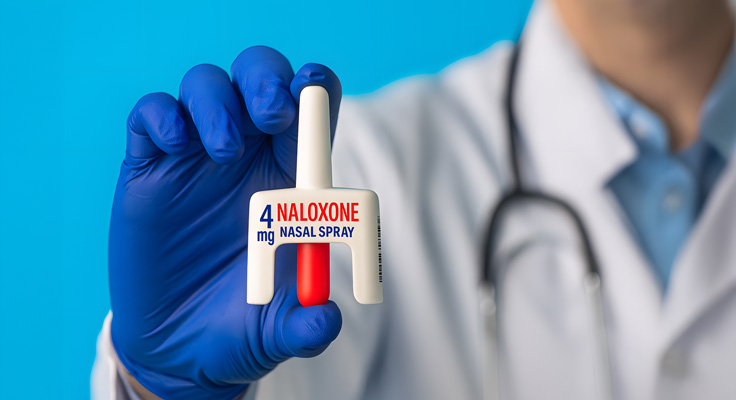
Today, an adequately stocked workplace overdose kit or a wall-mounted naloxone station is still the single most important piece of overdose response equipment a business can have. This past May, the DEA issued a “Public Safety Advisory” that every employer, hotel manager, and school administrator needs to read.
The illicit drug supply has shifted, and that means how we equip our businesses and respond to overdoses has to change, too.
The DEA’s Warning to the Public
The DEA released an urgent public safety advisory on May 12, 2026, identifying four substances routinely showing up, mixed in with street drugs alongside fentanyl:1
- Xylazine – a veterinary cattle tranquilizer not approved for human use
- Medetomidine – another animal tranquilizer increasingly found in illicit drug supplies
- Nitazenes – an old class of synthetic opioids, some more potent than fentanyl itself
- Cychlorphine – an emerging synthetic opioid estimated to be 10 times more potent than fentanyl2
The critical problem is that for anyone managing a workplace overdose preparedness plan, naloxone cannot completely reverse all these substances.
Xylazine and medetomidine are not opioids. Naloxone works by binding to the opioid receptors and blocking them, but these veterinary sedatives attack the brain in a different way. A person who has taken a fentanyl-xylazine mixture may still be unconscious and still not breathing normally, even after a dose of naloxone has been administered.
Nitazenes and cychlorphine are opioids, but they bind very aggressively to opioid receptors and are more potent than fentanyl. A single dose of naloxone tucked away in a desk drawer may not be enough to reverse their effects. That is why a purpose-built, wall-mounted naloxone dispenser stocked for today’s drug supply is the new standard.
Why the Drug Supply Got More Dangerous
The drug supply didn’t become dangerous overnight. Understanding how we got here helps make the case for better preparedness for opioid overdoses in your workplace, hotel, school, or facility.
In recent years, fentanyl has been the dominant force for overdose deaths, but international pressure and crackdowns on chemicals in 2023 and 2025 did reduce fentanyl availability in some areas.5 Overdose deaths have been on the decline, down about 14% nationally in 2025, and down 27% in 2024 compared to 2023.3, 4 That is real progress toward a safer future.
But disrupting fentanyl supply hasn’t eliminated the drug market; it has simply shifted to other substances. As nitazenes came under tighter control – the U.K. adopted a generic ban in January 2025 and China followed with its own generic scheduling in July 2025 – newer synthetic opioids have continued to emerge. Cychlorphine, first identified in the U.S. drug supply by a DEA laboratory in April 2024, is one such substance. Even as fentanyl levels go down in the drug supply, a different, stronger substance tends to replace it.
The drug supply is now becoming, as the DEA put it, “more unpredictable and more lethal than ever before.”
Naloxone still works on opioid overdoses, and fentanyl is still present in most street drugs, so continue to administer it immediately. But understand that if xylazine or medetomidine is also present, naloxone will only address the opioid component. The person may remain unresponsive or have abnormal breathing even after the first dose takes effect.
The Business Case: Your Naloxone Station Is Your AED for Opioids
Think about how your business approaches AEDs – automated external defibrillators. They’re wall-mounted. They’re accessible. Staff are trained to use them. Nobody debates whether to have one; it’s a baseline expectation for any responsible business.
A naloxone station is the AED for opioids. The difference is that the overdose-response station is still lagging behind. Most hotels, schools, warehouses, and restaurants don’t have a dedicated wall-mounted naloxone dispenser on site, which means businesses that install one today are ahead of incoming regulations.
More states are mandating workplace naloxone. OSHA guidance is evolving. The question is no longer if your facility needs a naloxone station; it’s whether you’ll have one in place before it’s required.
How ODRescue’s Naloxone Stations Are Built for This Moment
ODRescue™ designs wall-mounted overdose response stations specifically for businesses, schools, hotels, and high-traffic facilities. Their intent and design are the same as a fire extinguisher or an AED — to be visible, accessible, and ready to save a life.
ODRescue™ Box — Transparent, wall-mounted, with an app-based reporting tool so you always know your station’s status. The core naloxone dispenser for small businesses and cost-conscious buyers.
ODRescue Alarm™ — Everything in the Box, plus an audible alarm that sounds when pulled off the wall, immediately drawing the attention of nearby staff. Built for restaurants, warehouses, and transit hubs where every second counts.
ODRescue Alert™ — The enterprise-grade smart naloxone alert system uses Bluetooth connectivity to notify first responders via texts and calls immediately when the BLE seal tag is pulled. It’s ideal for hotels, large campuses, and large-scale businesses.
All three are designed to hold multiple doses, mount to any wall, and put a complete workplace overdose kit exactly where your staff can find it — without searching, without delay. (Naloxone sold separately)
The illicit drug supply landscape has changed. Ensure your emergency response station is ready to act.
See ODRescue’s full line of naloxone stations and find the right fit for your facility at odrescue.com
Sources:
- DEA Public Safety Advisory, May 12, 2026
- Center for Forensic Science Research and Education (CFSRE) Public Alert: Cychlorphine, January 2026
- Overdose Prevention — About | CDC
- U.S. Overdose Deaths Decrease Almost 27% in 2024 | CDC NCHS Press Release
- China’s Fentanyl Crackdown Led to a Stunning Drop in U.S. Overdoses | The Washington Post